From Figma to Production
What does “production-ready” really mean for a modern Product Designer?
Insights

From Figma to Production
For a long time, the design process was simple: Designer creates the design. Developer receives the design. Developer builds it. Designer reviews it. Today, this process is changing. AI and new design tools are making the gap between design and development much smaller.
A Figma file is not a product
A design can look perfect in Figma. But the real product has many things that don't appear in a static screen. What happens when there is no data? What happens when an API fails? What happens when the internet is slow? What happens when the user enters something incorrectly? What happens on a smaller screen? These are also design problems.
Designers need to think about states
A good interface isn't only the happy path.
It also includes:
loading
empty
error
success
disabled
offline
permission states
Thinking about these states makes a design much stronger.

Designers are becoming more technical
I don't think every Product Designer needs to become a developer. But understanding technology is becoming very useful. Knowing basic HTML and CSS helps. Understanding components helps. Understanding APIs helps. Understanding responsive behavior helps. Understanding design tokens helps. The goal isn't to write all the code. The goal is to understand what happens after the design leaves Figma.
Design systems become even more important
AI can generate many screens very quickly. But without a design system, those screens can become inconsistent. Different spacing. Different buttons. Different typography. Different interaction patterns. A good design system gives the product a clear language. It also gives AI better rules to follow.
The handoff is changing
I think the future is less about:
Design → Handoff → Development
and more about:
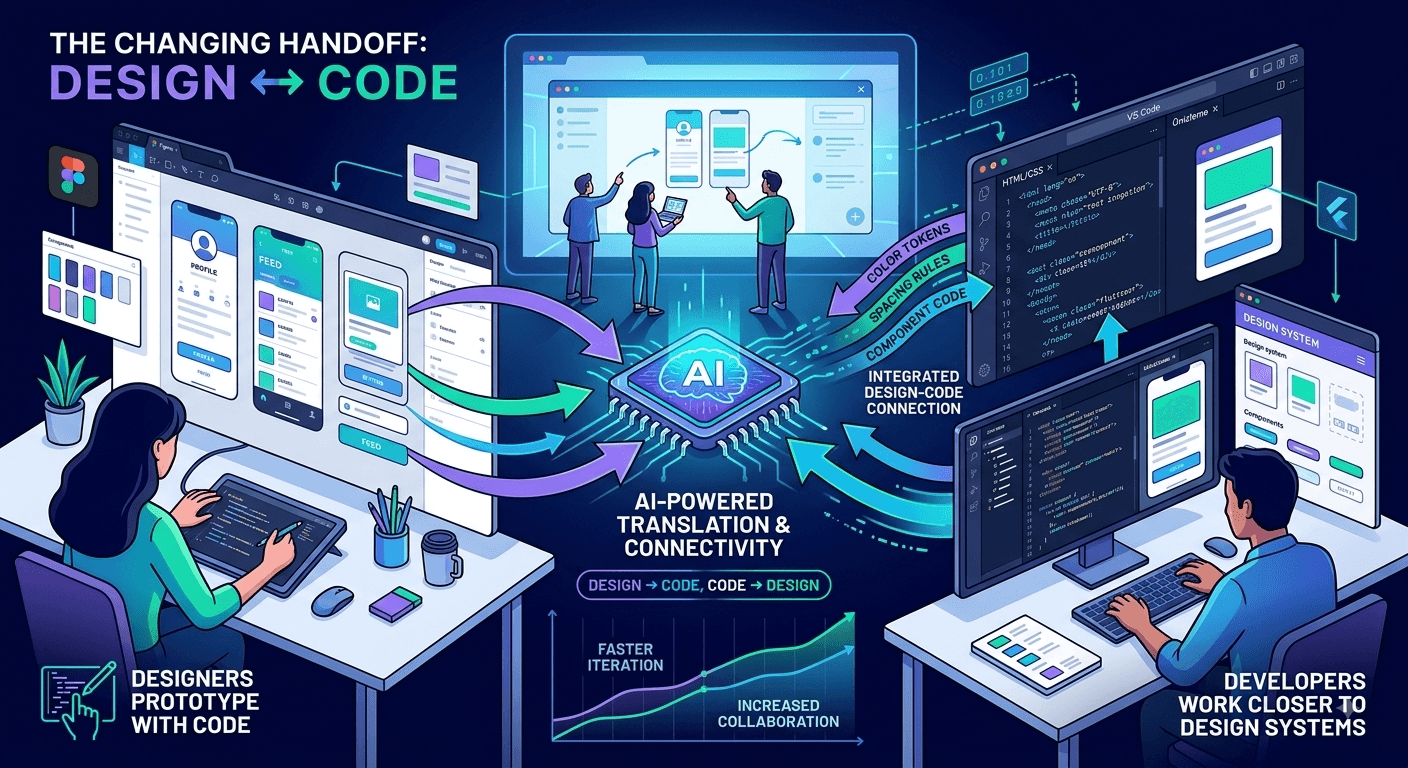
Design ↔ Code
Designers can prototype with code. Developers can work closer to design systems. AI can help translate between design and implementation. This creates a more connected workflow.
What does production-ready mean?
For me, production-ready doesn't mean that every pixel is perfect. It means the team understands how the experience should work.
The design includes:
visual hierarchy
interaction
responsive behavior
states
accessibility
content
edge cases
system rules
The goal is to remove uncertainty.
Final thought
I don't think the future Product Designer will live only inside Figma. We will move between research, design, AI, prototypes, code and product data. And that is a good thing. Because the goal isn't to create a perfect design file. The goal is to create a better product.
Key takeaway
Good Product Design doesn't end in Figma. It starts becoming real after Figma.
Sources & Further Reading
Figma — Config 2026 (figma.com)
Figma — The Figma Design Agent Is Here (figma.com)
Figma — The Figma Design Agent, Now With Custom Tools and Greater Context (figma.com)

More to Discover

From Figma to Production
What does “production-ready” really mean for a modern Product Designer?
Insights
From Figma to Production
For a long time, the design process was simple: Designer creates the design. Developer receives the design. Developer builds it. Designer reviews it. Today, this process is changing. AI and new design tools are making the gap between design and development much smaller.
A Figma file is not a product
A design can look perfect in Figma. But the real product has many things that don't appear in a static screen. What happens when there is no data? What happens when an API fails? What happens when the internet is slow? What happens when the user enters something incorrectly? What happens on a smaller screen? These are also design problems.
Designers need to think about states
A good interface isn't only the happy path.
It also includes:
loading
empty
error
success
disabled
offline
permission states
Thinking about these states makes a design much stronger.
Designers are becoming more technical
I don't think every Product Designer needs to become a developer. But understanding technology is becoming very useful. Knowing basic HTML and CSS helps. Understanding components helps. Understanding APIs helps. Understanding responsive behavior helps. Understanding design tokens helps. The goal isn't to write all the code. The goal is to understand what happens after the design leaves Figma.
Design systems become even more important
AI can generate many screens very quickly. But without a design system, those screens can become inconsistent. Different spacing. Different buttons. Different typography. Different interaction patterns. A good design system gives the product a clear language. It also gives AI better rules to follow.
The handoff is changing
I think the future is less about:
Design → Handoff → Development
and more about:
Design ↔ Code
Designers can prototype with code. Developers can work closer to design systems. AI can help translate between design and implementation. This creates a more connected workflow.
What does production-ready mean?
For me, production-ready doesn't mean that every pixel is perfect. It means the team understands how the experience should work.
The design includes:
visual hierarchy
interaction
responsive behavior
states
accessibility
content
edge cases
system rules
The goal is to remove uncertainty.
Final thought
I don't think the future Product Designer will live only inside Figma. We will move between research, design, AI, prototypes, code and product data. And that is a good thing. Because the goal isn't to create a perfect design file. The goal is to create a better product.
Key takeaway
Good Product Design doesn't end in Figma. It starts becoming real after Figma.
Sources & Further Reading
Figma — Config 2026 (figma.com)
Figma — The Figma Design Agent Is Here (figma.com)
Figma — The Figma Design Agent, Now With Custom Tools and Greater Context (figma.com)
More to Discover
From Figma to Production
What does “production-ready” really mean for a modern Product Designer?
Insights
From Figma to Production
For a long time, the design process was simple: Designer creates the design. Developer receives the design. Developer builds it. Designer reviews it. Today, this process is changing. AI and new design tools are making the gap between design and development much smaller.
A Figma file is not a product
A design can look perfect in Figma. But the real product has many things that don't appear in a static screen. What happens when there is no data? What happens when an API fails? What happens when the internet is slow? What happens when the user enters something incorrectly? What happens on a smaller screen? These are also design problems.
Designers need to think about states
A good interface isn't only the happy path.
It also includes:
loading
empty
error
success
disabled
offline
permission states
Thinking about these states makes a design much stronger.
Designers are becoming more technical
I don't think every Product Designer needs to become a developer. But understanding technology is becoming very useful. Knowing basic HTML and CSS helps. Understanding components helps. Understanding APIs helps. Understanding responsive behavior helps. Understanding design tokens helps. The goal isn't to write all the code. The goal is to understand what happens after the design leaves Figma.
Design systems become even more important
AI can generate many screens very quickly. But without a design system, those screens can become inconsistent. Different spacing. Different buttons. Different typography. Different interaction patterns. A good design system gives the product a clear language. It also gives AI better rules to follow.
The handoff is changing
I think the future is less about:
Design → Handoff → Development
and more about:
Design ↔ Code
Designers can prototype with code. Developers can work closer to design systems. AI can help translate between design and implementation. This creates a more connected workflow.
What does production-ready mean?
For me, production-ready doesn't mean that every pixel is perfect. It means the team understands how the experience should work.
The design includes:
visual hierarchy
interaction
responsive behavior
states
accessibility
content
edge cases
system rules
The goal is to remove uncertainty.
Final thought
I don't think the future Product Designer will live only inside Figma. We will move between research, design, AI, prototypes, code and product data. And that is a good thing. Because the goal isn't to create a perfect design file. The goal is to create a better product.
Key takeaway
Good Product Design doesn't end in Figma. It starts becoming real after Figma.
Sources & Further Reading
Figma — Config 2026 (figma.com)
Figma — The Figma Design Agent Is Here (figma.com)
Figma — The Figma Design Agent, Now With Custom Tools and Greater Context (figma.com)